A Harbor Freight table saw can be a tempting entry point for DIY enthusiasts and homeowners looking to set up a basic workshop without very costly. These budget-friendly saws promise the core functionality of premium models at a fraction of the cost, but do they deliver the performance, accuracy, and reliability needed for real projects? Whether you’re building a deck, crafting raised garden beds, or tackling interior trim work, understanding what a Harbor Freight table saw actually offers helps you make an well-informed choice. This guide cuts through the noise to show you what you’re getting, what trade-offs come with the price tag, and whether it’s the right fit for your workshop goals.
Table of Contents
ToggleKey Takeaways
- A Harbor Freight table saw offers solid value for casual DIY projects like deck building and plywood breakdown, but requires $50–$150 in additional accessories and tuning to perform reliably.
- Budget saws struggle with vibration and precision compared to mid-range models, making them unsuitable for fine woodworking, cabinetry, or tasks requiring tight tolerances.
- Safety gaps like missing blade brakes and flimsy riving knives mean operator discipline and proper technique are critical—always use safety gear and push sticks on a Harbor Freight table saw.
- When factoring in blade upgrades, fence improvements, and time spent on alignment, total investment can reach $250–$350, narrowing the cost advantage over brand-name benchtop saws priced around $600–$800.
- Regular maintenance—keeping blades sharp, lubricating moving parts, checking blade alignment, and storing in dry conditions—extends the lifespan of budget saws significantly.
What You Get With a Harbor Freight Table Saw
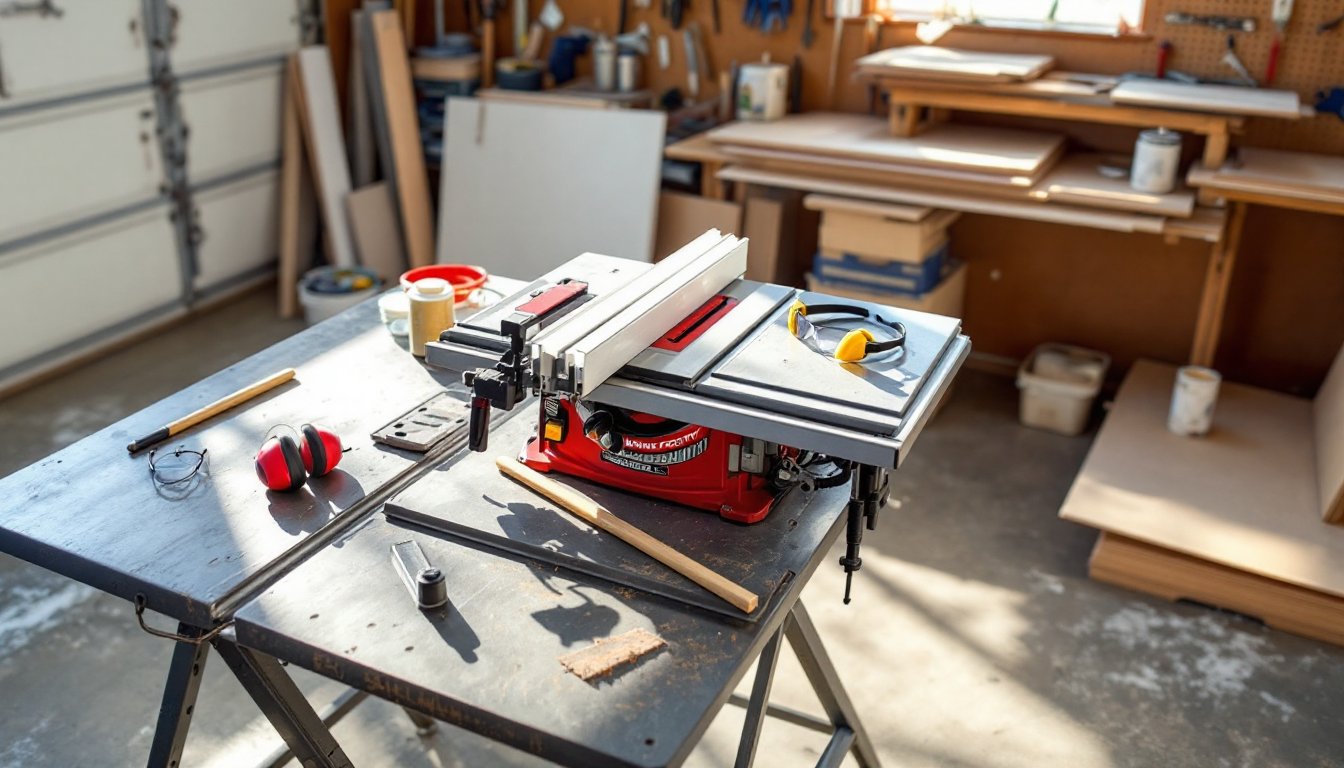
Harbor Freight table saws typically come in two categories: benchtop models and wheeled contractor-style designs. Benchtop saws weigh 80–150 pounds, sit on a fold-away stand, and are meant for occasional shop use or small projects. Contractor models run heavier (200–250 pounds) and include built-in stands with wheels for mobility.
Most budget models ship with a 10-inch blade, a rip fence, a crosscut miter gauge, and a dust port. Some packages bundle a basic blade, push stick, and instruction manual. The motor typically ranges from 1.5 to 2 horsepower and runs on 110V household current, no 220V wiring required.
Be honest with yourself about what’s missing: Many cheaper saws lack a precision rip fence that locks square to the blade. The miter gauge is often plastic and doesn’t glide smoothly. Dust collection is bare-bones. Out of the box, you’ll likely need to spend another $50–$150 on accessories like a better blade, a shop-made auxiliary fence, or a dust shroud to make the saw genuinely useful for quality work.
Performance and Build Quality
The core question: can a Harbor Freight table saw make clean, accurate cuts? Yes, but with caveats.
Benchtop saws often struggle with vibration, especially when ripping hardwoods or making repeat crosscuts. The lightweight base and thinner blade contribute to chatter and slight wandering. Contractor-style models improve here because added mass dampens vibration better. A quality table saw from Harbor Freight will get you straight rips and clean crosscuts for framing, plywood breakdown, and general carpentry, but don’t expect the precision needed for fine furniture joinery or cabinet face frames without significant tweaks.
Build quality is inconsistent. Some units arrive with a blade that isn’t parallel to the miter slot, a fence that wobbles, or a tilting mechanism that sticks. You may spend hours with shims, lubrication, and alignment checks before the saw performs well. This isn’t a failure of concept, many DIYers happily run old used machinery after tuning, but it’s labor on top of your purchase.
Motors are generally adequate for ripping dimensional lumber and plywood, though they’ll bog down quickly under heavy load or with dull blades. Don’t expect to rip thick hardwoods at speed.
Safety Features and Reliability
Safety is where budget saws show their biggest gaps. Most lack a blade brake, which stops the blade in a few seconds if you release the power switch. Premium saws all include one: Harbor Freight models usually don’t.
Guard and riving knife design on budget models is often flimsy. The riving knife, a thin metal arm behind the blade that prevents kickback, may not stay aligned with the blade or may feel loose. The transparent plastic guard can be hard to see through after dust accumulation.
No flesh-sensing technology (sawstop-style flesh detection) exists on budget saws, so prevention and operator discipline matter more. Always wear safety glasses and hearing protection. Keep hands clear of the blade path. Use the push stick for narrow rips. Never reach over or under a running blade.
Reliability over time is a mixed bag. Some units run for years with basic maintenance. Others develop motor issues, bearing wear, or electrical glitches within a couple of years of regular use. Harbor Freight’s return policy (generous at 90 days, decent up to a year with a credit card) helps, but you can’t replace a saw mid-project.
Cost Comparison: Budget vs. Premium Options
A Harbor Freight benchtop table saw runs $150–$300 on sale. Contractor-style models cost $300–$500. For comparison, a DeWalt or Makita benchtop saw starts around $400–$600, while a quality contractor saw from a major brand costs $700–$1,200.
On paper, Harbor Freight is half the price. In reality, once you factor in accessories, a better blade ($30–$60), a precision rip fence upgrade or DIY improvement ($40–$100), dust collection ($20–$80), and the time spent tuning alignment, the gap narrows. You might invest $250–$350 total in a Harbor Freight setup versus $600–$800 for a brand-name benchtop that arrives closer to ready.
The true calculus is frequency of use. If you’re building two decks over five years, the budget saw makes sense. If you’re running a steady stream of projects, furniture, cabinetry, house repairs, a mid-range saw saves frustration and time. Cost per project matters as much as upfront dollars.
Resale value also skews toward brand names. A used DeWalt holds 50–60% of its value: Harbor Freight models drop faster, making them less appealing if you upgrade later.
Best Uses for Homeowners and DIY Enthusiasts
A Harbor Freight table saw shines for specific, realistic tasks. If you’re cutting 2×4 lumber for a deck frame, ripping plywood for shelving, or breaking down sheet goods for interior projects, it works well. Deck building, fence repair, rough carpentry, and framing are all within reach.
Where it struggles: fine trim work, molding profiles, precise crosscuts for cabinet facing, or any task where ±1/16 inch tolerance matters. Serious woodworking, small-batch furniture builds, or commission work demand a better tool.
Think of it as a project-specific tool rather than a permanent workshop centerpiece. A homeowner tackling seasonal repairs or the occasional renovation might own one for five years and use it 20 times. A contractor running steady jobs needs something more robust. Resources like Bob Vila’s DIY guides and This Old House tutorials often assume access to better equipment, but many projects can adapt to simpler tools with extra care.
Maintenance Tips to Maximize Longevity
Getting years out of a budget saw requires discipline. Keep the blade clean and sharp, dull blades force the motor to work harder and increase burn and drift. Replace or sharpen every 8–12 months of regular use, or sooner if you notice rough edges.
Lubricate the blade arbor, tilt mechanism, and fence rails quarterly with a light machine oil. Wipe dust from the motor vents and keep the electrical cord away from the blade. Check that the blade is parallel to the miter slots every few months and shim as needed.
Store in a dry space. Rust on the steel table surface will affect glide and accuracy. A thin coat of paste wax or light oil keeps the table smooth. If you notice motor noise or reduced power, stop and inspect for debris inside the housing.
Don’t run the saw on a damaged extension cord or through a heavily loaded circuit. Voltage fluctuations stress cheap motors. Finally, keep the manual accessible: you’ll reference blade specifications, motor specs, and parts diagrams for repairs. Popular Mechanics’ workshop tips cover general power-tool care that applies here too.
Conclusion
A Harbor Freight table saw is honest value for weekend warriors and budget-conscious homeowners. It won’t match the precision or durability of mid-range saws, but it can handle real projects if you maintain it and respect its limits. Buy one if you’re a casual DIYer, anticipate sporadic use, and can tune it yourself. Skip it if you run frequent projects or demand tight tolerances. Know what you’re buying, a tool that cuts, not a precision instrument, and you’ll get good use from it.